
Books from SpaceMath
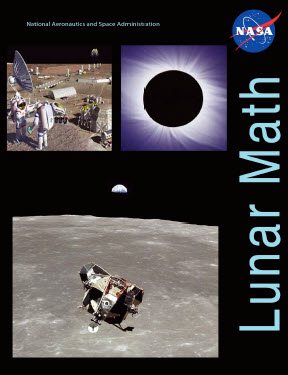
Lunar Math (2008)- [3.8 Mby, 17 Problems] An exploration of the moon using NASA photographs and scaling activities. Mathematical modeling of the lunar interior, and problems involving estimating its total mass and the mass of its atmosphere.
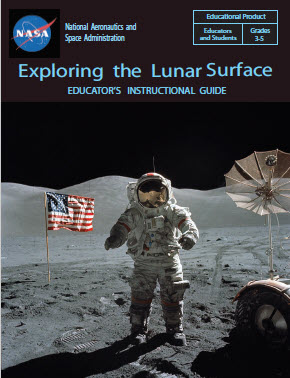
Exploring the Lunar Surface (2013)- [6.0 Mby, 10 Problems] An introduction to the appearance of the lunar surface using a zoom-in from the full moon to the Apollo-11 landing area. Problems include basic scales and proportions.Also included are hands-on activities for building spacecraft, weightlessness and modeling lunar crater formation. Suitable for Grades 3-5.
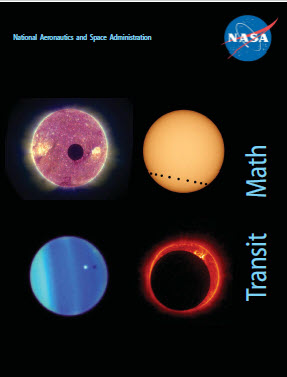
Transit Math (2010: 44 Problems Students explore astronomical eclipses, transits and occultations to learn about their unique geometry, and how modern observations by NASA's Kepler Satellite will use transit math to discover planets orbiting distant stars. A series of Appendices reveal the imagery and history through news paper articles of the Transits of Venus observed during the 1700 and 1800s. [Click here]
Math problems about our Moon
Problem 607: The Launch of LADEE to the Moon
Students plot the altitude, range and speed of the LADEE rocket launch and investigate rates of change including acceleration by graphing the tabular data and determining the slope of the graph using the definition of the slope of a line between two points.
[Grade: 6-8 | Topics: Graphing tabular data; determining the slope of a line; rates of change]
[Click here]
Problem 509:Gail Spacecraft Creates a New Crater on the Moon
Students work with images of the Grail impact sites to estimate the diameter of the crater created
after the spacecraft impacted the moon.
[Grade: 6-8 | Topics: scale and proportion; volume of cylinder; mass=DensityxVolume]
[Click here]
Problem 504: Grail Satellites Create a Gravity Map of the Moon
Students explore the gravity field of the moon, and the behavior of simple pendulum clocks in places on the moon where the local gravity is slightly different.
[Grade: 9-12 | Topics: square-roots; evaluating equations]
[Click here]
Problem 495: The Volume of a Lunar Impact Crater
Students use calculus to determine the volume of a crater whose depth is defined by a fourth-order polynomial
[Grade: 12 | Topics: Integration involving vollumes of rotation]
[Click here]
Problem 478: The Grail and LRO Encounter in Lunar Orbit
Students explore the May 31, 2012 encounter between NASA's Grail and LRO spacecraft in orbit around the moon. Will the Grail/Ebb spacecraft be able to photograph the LRO spacecraft as it passes-by?
[Grade: 9-12 | Topics: formula for an ellipse; semi-major and minor axis]
[Click here]
Problem 445: LRO - The relative ages of lunar surfaces
Students examine two Apollo landing areas using images from the LRO spacecraft to estimate the relative ages of the two regions using
crater counting. [Grade: 6-8 | Topics: scale; histogramming]
[Click here]
Problem 440: LRO explores the Apollo 12 landing area on the moon
Students use a recent image obtained by the LRO spacecraft to estimate how far astronauts walked to get to various points in the
landing area.
They also estimate how many craters are in this area and the average impact time between crater events.
[Grade: 6-8 | Topics: image scale; metric measurement]
[Click here]
Problem 435: Apollo-17 Launch from Lunar Surface
Students use a sequence of images to determine the speed of ascent of the Apollo-17 capsule from the lunar surface.
[Grade: 6-8 | Topics: scale, metric measurement, speed=distance/time]
[Click here]
Problem 394: Probing the lunar core using seismology Students learn about the geometry needed to determine the diameter of the lunar core using a simplified model. [Grade: 9-10 | Topics: Geometry; Properties of Inscribed Arcs] [Click here]
Problem 378: LRO Makes a Temperature Map of the Lunar South Pole
Students use the published LRO temperature map to study the scale of the south polar region, the sizes of its craters,
and estimate the volume of water-ice that may be present in the Shackleton Crater.
[Grade: 7-9 | Topics: Volume of a circular disk; scale models]
[Click here]
Problem 372: LRO Determines Lunar Cratering History
Students count large craters on an LRO coded image of the lunar surface to estimate whether the impacting asteroids
that produced the largest
craters were from the same population of asteroids during the two different epocs of impacts.
[Grade: 6-8 | Topics: Scaled images; probability; percentages]
[Click here]
Problem 321: Lunar Crater Frequency Distributions Students use an image from the LRO satellite of the Apollo-11 landing area, along with a power-law model of cratering, to determine what fraction of the landing area was safe to land upon. [Grade: 11-12 | Topics: Integral calculus] [Click here]
Problem 296: Getting an Angle on the Sun and Moon Students explore angular size and scale by comparing two images of the sun and moon that have identical angular size, but vastly different scales. [Grade: 8-10 | Topics: Geometry; angle measure; scale; proportion] [Click here]
Problem 290: The Apollo-11 Landing Area at High Resolution Students use recent images made by the LRO satellite to estimate distances, crater sizes, and how many tons of TNT were needed to create some of the craters by meteor impact. [Grade: 9-12 | Topics: metric measurement; scaling; A = B/C] [Click here]
Problem 287: LCROSS Sees Water on the Moon Students use information about the plume created by the LCROSS impactor to estimate the (lower-limit) concentration of water in the lunar regolith in a shadowed crater. [Grade: 9-12 | Topics: Geometry; volumes; mass=density x volume] [Click here]
Problem 275: Water on the Moon! Students estimate the amount of water on the moon using data from Deep Impact/EPOXI and NASA's Moon Minerology Mapper experiment on the Chandrayaan-1 spacecraft. [Grade: 8-10 | Topics: Geometry, Spherical volumes and surface areas, Scientific notation] [Click here]
Problem 267: Identifying Materials by their Reflectivity The reflectivity of a material can be used to identify it. This is important when surveying the lunar surface for minerals, and also in creating 'green' living environments on Earth. [Grade: 6-8 | Topics: percentage, interpreting tabular data, area ] [Click here]
Problem 262: LRO Explores Lunar Surface Cratering Students count the number of craters in various size ranges from a high-resolution image of the lunar surface. [Grade: 6-8 | Topics: scale, proportion, ratio, area, density] [Click here]
Problem 261: LRO - Searching for Lunar Boulders Students use a recent image of the Apollo-11 landing area to search for large lunar boulders. [Grade: 6-8 | Topics: scale, ratio, proportion] [Click here]
Problem 259: Mare Nubium And Las Vegas Students comare two satellite images taken at the same resolution to appreciate how large lunar features ae compared to more familiar objects. [Grade: 8-10 | Topics: scale, proportion, ratio] [Click here]
Problem 258: LRO's First Image of Mare Nubium Students examine the first image of this lunar region using the high-resolution camera image provided by the Lunar Reconnaissance Orbiter. [Grade: 6-8 | Topics: scale, ratio, proportion] [Click here]
Problem 257: LRO and the Apollo-11 Landing Site Students examine a map of the Apollo-11 landing area and determine how well various features will be visible to the Lunar Reconnaissance Orbiter high-resolution camera. [Grade: 6-8 | Topics: scale, proportion, ratios] [Click here]
Problem 256: A High-resolution Satellite Photo Students examine a satelite photo of the Tennessee Court House from the GEO-1 satellite and determine the sizes of familiar features in the image. [Grade: 6-8 | Topics: scale, ratios, proportions' angle measure, triangle geometry] [Click here]
Problem 250: The Most Important Equation in Astronomy Students learn about how an instrument's ability to see details depends on its size and its operating wavelength - the key to designing any telescope or camera. [Grade: 8-10 | Topics: geometry, angle measure, scientific notation] [Click here]
Problem 241: Angular Size and Similar Triangles A critical concept in astronomy is angular size, measured in degrees, minutes or arc-seconds. This is a review of the basic properties of similar triangles for a fixed angle. [Grade: 8-10 | Topics: geometry, similar triangles, proportions] [Click here]
Problem 236: LRO Sees Apollo-11 on the Moon! Students use the latest image from the Lunar Reconnaissance Orbiter of the Apollo-11 landing site to explore lunar features at 1-meter resolution, and determine the solar elevation angle. [Grade: 6-8 | Topics: scale; ratios; angle measure; right triangles] [Click here]
Problem 235: Scientific Data: The gift that keeps on giving! Students learn about gigabytes and terrabytes of data and the rates of data generation by NASA missions and how to store it. [Grade: 6-8 | Topics: metric units; rates; money] [Click here]
Problem 223: Volcanos are a Blast: Working with simple equations- Students examine the famous Krakatoa explosion, asteroid impacts on the moon, and geysers on Enceladus using three equations that describe the height of the plume and initial velocity, to answer questions about the speed of the debris and terminal height. [Grade: 9-11 | Topics: Algebra I; significant figures.] [Click here]
Problem 218: Craters are a Blast! - Students measure crater diameters in a photo of the moon, and determine the energy required to create them using a simple quadratic equation. [Grade: 8-10 | Topics: Scientific notation; evaluating simple power equations.] [Click here]
Problem 212: Finding Mass in the Cosmos- Students derive a simple formula, then use it to determine the masses of objects in the universe from the orbit periods and distances of their satellites. [Grade: 9-12| Topics: Scientific Notation; Algebra II; parametric equations] [Click here]
Problem 211: Where Did All the Stars Go?- Students learn why NASA photos often don't show stars because of the way that cameras take pictures of bright and faint objects. [Grade: 6-8| Topics: multiplication; division; decimal numbers.] [Click here]
Problem 201: Fly Me To the Moon!- Students learn some basic principles and terminology about how spacecraft change their orbits to get to the moon. [Grade: 6-8| Topics: speed = distance/time; Pythagorean Theorem] [Click here]
Problem 200: The Moon's Density - What's Inside?- Students develop a simple mathematical model of the moon's interior using two nested spheres with different densities. [Grade: 9-12| Topics: Volume of a sphere; mass = density x volume.] [Click here]
Problem 181: Extracting Oxygen from Moon Rocks- Students use a chemical equation to estimate how much oxygen can be liberated from a sample of lunar soil. [Grade: 9-11| Topics: ratios; scientific notation; unit conversions] [Click here]
Problem 179: Is There a Lunar Meteorite Impact Hazard? - Students work with areas, probability and impact rates to estimate whether lunar colonists are in danger of meteorite hazards. [Grade: 5-7| Topics: Area; unit conversions; rates] [Click here]
Problem 178: The Mass of the Moon - Students use the period and altitude of a NASA lunar spacecraft to determine the mass of the moon. [Grade: 8-11| Topics: Algebra] [Click here]
Problem 177: Lunar Cratering: Probability and Odds- Students work with crater counting to estimate the area covered by craters and how to convert this into impact probabilities. [Grade: 4-7| Topics: Area; probability] [Click here]
Problem 155: Tidal Forces: Let 'er rip! - Students explore tidal forces and how satelites are destroyed by coming too close to their planet. [Grade: 7-10| Topics: Algebra; number substitution] [Click here]
Problem 134 The Last Total Solar Eclipse--Ever! Students explore the geometry required for a total solar eclipse, and estimate how many years into the future the last total solar eclipse will occur as the moon slowly recedes from Earth by 3 centimeters/year. [Grade: 7 - 10 | Topics:Simple linear equations] [Click here]
Problem 129 How Big is It? - The Moon up close. Students work with an image taken by the Lunar Orbiter III spacecraft to determine image scale, and search for the smallest things seen in a photograph. [Grade: 4 - 7 | Topics:image scaling; multiply, divide, work with millimeter ruler] [Click here]
Problem 127 How Big is It? - The Moon up close. Students work with an image taken by the Lunar Orbiter IV spacecraft to determine image scale, and search for the smallest things seen in a photograph. [Grade: 4 - 7 | Topics:image scaling; multiply, divide, work with millimeter ruler] [Click here]
Problem 124 The Moon's Atmosphere! Students learn about the moon's very thin atmosphere by calculating its total mass in kilograms using the volume of a spherical shell and the measured density. [Grade: 8-10 | Topics:volume of sphere, shell; density-mass-volume; unit conversions] [Click here]
Problem 92 A Lunar Transit of the Sun from Space - One of the STEREO satellites observed the disk of the moon pass across the sun. Students will use simple geometry to determine how far the satellite was from the moon and Earth at the time the photograph was taken. [Grade level: 9-11 | Topics: Geometry; parallax; arithmetic] [Click here]
Problem 84 Beyond the Blue Horizon - How far is it to the horizon? Students use geometry, and the Pythagorean Theorem, to determine the formula for the distance to the horizon on any planet with a radius, R, from a height, h, above its surface. Additional problems added that involve calculus to determine the rate-of-change of the horizon distance as you change your height. [Grade level: 9-11 | Topics: Algebra, Pythagorean Theorem; Experts: DIfferential calculus) ] [Click here]
Problem 83 Luner Meteorite Impact Risks - In 2006, scientists identified 12 flashes of light on the moon that were probably meteorite impacts. They estimated that these meteorites were probably about the size of a grapefruit. How long would lunar colonists have to wait before seeing such a flash within their horizon? Students will use an area and probability calculation to discover the average waiting time. [Grade level: 8-10 | Topics: arithmetic; unit conversions; surface area of a sphere) ] [Click here]