

Space Math @ NASA Problem Books
This page contains a complete collection of books and other Space Math products in PDF format, which are available to download. Note the large file sizes! Also, these documents are full-color, and contain additional explanatory materials about the content and how the topics align with national mathematics and science standards identified by the National Council of Teachers of Mathematics and the National Science Teachers Association.
These books include most of the weekly math problems assembled by year or by special topic area, in a format that may be more convenient for the teacher than the individual weekly problem downloads. All books contain problems for a mixture of grade levels from 4th through 8th and beyond.
The links below take you to the PDF files.
Annual Math Problem Collections
 Adventures in Space Science Mathematics (2004)
15 Problems - This series of math activities will help students understand some of the real life
applications of mathematics in the study of the Sun and Earth as a system.
Through math and reading activities, students will learn: How to search for trends and correlations in data;
extract the average, maximum and minimum from data; use scientific notation to work with very large and small numbers; use a scale drawing to
estimate the sizes of an aurora; use the Pythagorean Theorem to calculate magnetic field strength; and how to use simple equations to convert raw data into physical quantities
[PDF: 5.7 Mby; 25 pages]
Adventures in Space Science Mathematics (2004)
15 Problems - This series of math activities will help students understand some of the real life
applications of mathematics in the study of the Sun and Earth as a system.
Through math and reading activities, students will learn: How to search for trends and correlations in data;
extract the average, maximum and minimum from data; use scientific notation to work with very large and small numbers; use a scale drawing to
estimate the sizes of an aurora; use the Pythagorean Theorem to calculate magnetic field strength; and how to use simple equations to convert raw data into physical quantities
[PDF: 5.7 Mby; 25 pages]
 Space Math I (2005)
20 Problems - This book includes the weekly math problems (Year1 - 1 to 38) assembled during the 2004-2005 school year, and
in a 48-page format that may be more convenient for the teacher than the individual weekly problem downloads.
The problems span a variety of math skills in grades 7-10 pre-algebra and algebra.
[PDF: 7.2 Mby; 48 pages]
Space Math I (2005)
20 Problems - This book includes the weekly math problems (Year1 - 1 to 38) assembled during the 2004-2005 school year, and
in a 48-page format that may be more convenient for the teacher than the individual weekly problem downloads.
The problems span a variety of math skills in grades 7-10 pre-algebra and algebra.
[PDF: 7.2 Mby; 48 pages]
 Space Math II (2006)
24 Problems - This book includes the weekly math problems (Year2 - 39 to 64) assembled during the 2005-2006 school year, and
in a 56-page format that may be more convenient for the teacher than the individual weekly problem downloads.
The problems span a variety of math skills in grades 7-10 pre-algebra and algebra.
[PDF: 13.8 Mby; 56 pages]
Space Math II (2006)
24 Problems - This book includes the weekly math problems (Year2 - 39 to 64) assembled during the 2005-2006 school year, and
in a 56-page format that may be more convenient for the teacher than the individual weekly problem downloads.
The problems span a variety of math skills in grades 7-10 pre-algebra and algebra.
[PDF: 13.8 Mby; 56 pages]
 Space Math III (2007)
36 Problems - This book includes the weekly math problems (Year3 - 65 to 101) assembled during the 2006-2007 school year, and
in a 86-page format that may be more convenient for the teacher than the individual weekly problem downloads.
The problems span a variety of math skills in grades 7-10 pre-algebra, algebra and calculus.
[PDF: 13.6 Mby; 86 pages]
Space Math III (2007)
36 Problems - This book includes the weekly math problems (Year3 - 65 to 101) assembled during the 2006-2007 school year, and
in a 86-page format that may be more convenient for the teacher than the individual weekly problem downloads.
The problems span a variety of math skills in grades 7-10 pre-algebra, algebra and calculus.
[PDF: 13.6 Mby; 86 pages]
 Space Math IV (2008)
31 Problems - This book includes the weekly math problems (Year4 - 102 to 148) assembled during the 2007-2008 school year, and
in a 69-page format that may be more convenient for the teacher than the individual weekly problem downloads.
The problems span a variety of math skills in grades 7-10 pre-algebra and algebra.
[PDF: 11.7 Mby; 69 pages]
Space Math IV (2008)
31 Problems - This book includes the weekly math problems (Year4 - 102 to 148) assembled during the 2007-2008 school year, and
in a 69-page format that may be more convenient for the teacher than the individual weekly problem downloads.
The problems span a variety of math skills in grades 7-10 pre-algebra and algebra.
[PDF: 11.7 Mby; 69 pages]
 Space Math V (2009)
87 Problems - This book includes the weekly math problems (Year5 - 149 to 233) assembled during the 2008-2009 school year, and
in a 192-page format that may be more convenient for the teacher than the individual weekly problem downloads.
The problems span a variety of math skills in grades 7-10 pre-algebra, algebra and calculus.
[PDF: 11.1 Mby; 192 pages]
Space Math V (2009)
87 Problems - This book includes the weekly math problems (Year5 - 149 to 233) assembled during the 2008-2009 school year, and
in a 192-page format that may be more convenient for the teacher than the individual weekly problem downloads.
The problems span a variety of math skills in grades 7-10 pre-algebra, algebra and calculus.
[PDF: 11.1 Mby; 192 pages]
 Space Math VI (2010)
87 Problems - This book includes the weekly math problems (Year6 - 234 to 342) assembled during the 2009-2010 school year, and
in a 233-page format that may be more convenient for the teacher than the individual weekly problem downloads.
The problems span a variety of math skills in grades 7-10 pre-algebra, algebra and calculus.
[PDF: 11.1 Mb; 233 pages]
Space Math VI (2010)
87 Problems - This book includes the weekly math problems (Year6 - 234 to 342) assembled during the 2009-2010 school year, and
in a 233-page format that may be more convenient for the teacher than the individual weekly problem downloads.
The problems span a variety of math skills in grades 7-10 pre-algebra, algebra and calculus.
[PDF: 11.1 Mb; 233 pages]
 Space Math VII (2011)
86 Problems - This book includes the weekly math problems (Year7 - 343 to 428) assembled during the 2010-2011 school year, and
in a 188-page format that may be more convenient for the teacher than the individual weekly problem downloads.
The problems span a variety of math skills in grades 7-10 pre-algebra, algebra and calculus.
[PDF: 14.6 Mby; 188 pages]
Space Math VII (2011)
86 Problems - This book includes the weekly math problems (Year7 - 343 to 428) assembled during the 2010-2011 school year, and
in a 188-page format that may be more convenient for the teacher than the individual weekly problem downloads.
The problems span a variety of math skills in grades 7-10 pre-algebra, algebra and calculus.
[PDF: 14.6 Mby; 188 pages]
 Space Math VIII (2012)
49 Problems - This book includes the weekly math problems (Year8 - 429 to 478) assembled during the 2011-2012 school year, and
in a 112-page format that may be more convenient for the teacher than the individual weekly problem downloads.
The problems span a variety of math skills in grades 7-10 pre-algebra and algebra.
[PDF: 6.3 Mby; 112 pages]
Space Math VIII (2012)
49 Problems - This book includes the weekly math problems (Year8 - 429 to 478) assembled during the 2011-2012 school year, and
in a 112-page format that may be more convenient for the teacher than the individual weekly problem downloads.
The problems span a variety of math skills in grades 7-10 pre-algebra and algebra.
[PDF: 6.3 Mby; 112 pages]
 Space Math IX (2013)
106 Problems - This book includes the weekly math problems (Year9 - 479 to 517)
and 65 additional problems from individual NASA missions, assembled during the 2012-2013 school year.
The problems span a variety of math skills in grades 7-10 pre-algebra and algebra.
[PDF: 12.3 Mby; 231 pages]
Space Math IX (2013)
106 Problems - This book includes the weekly math problems (Year9 - 479 to 517)
and 65 additional problems from individual NASA missions, assembled during the 2012-2013 school year.
The problems span a variety of math skills in grades 7-10 pre-algebra and algebra.
[PDF: 12.3 Mby; 231 pages]
 Space Math X (2014)
140 Problems - This book includes the weekly math problems (Year10 - 518 to 692)
assembled during the 2013-2014 school year. The problems span a variety of math skills in grades 3-10 pre-algebra and algebra.
[PDF: 17.3 Mby; 300 pages]
Space Math X (2014)
140 Problems - This book includes the weekly math problems (Year10 - 518 to 692)
assembled during the 2013-2014 school year. The problems span a variety of math skills in grades 3-10 pre-algebra and algebra.
[PDF: 17.3 Mby; 300 pages]
Special Topic Guides
 Black Hole Math (2012)
53 Problems This is a revised and expanded version of the book Black Hole Math (2008),which provides an introduction to the basic properties of black holes using elementary algebra
and geometry. Students calculate black hole sizes from their mass, time and space distortion, learn about world lines, light cones and simple spacetime diagrams,
and explore the impact that black holes have upon their surroundings.
[PDF: 7.5 Mby ]
Black Hole Math (2012)
53 Problems This is a revised and expanded version of the book Black Hole Math (2008),which provides an introduction to the basic properties of black holes using elementary algebra
and geometry. Students calculate black hole sizes from their mass, time and space distortion, learn about world lines, light cones and simple spacetime diagrams,
and explore the impact that black holes have upon their surroundings.
[PDF: 7.5 Mby ]
 Image Scaling (2008)
11 Problems
Students work with a number of NASA photographs of planets, stars and galaxies to determine the scales of the
images, and to examine the sizes of various features within the photographs using simple ratios and proportions.
[PDF: 7.3 Mby ]
Image Scaling (2008)
11 Problems
Students work with a number of NASA photographs of planets, stars and galaxies to determine the scales of the
images, and to examine the sizes of various features within the photographs using simple ratios and proportions.
[PDF: 7.3 Mby ]
 Solar Math (2012)
99 Problems
This is a revised and expanded version of the book Hinode Math (2008), featuring problems about the sun from many NASA science missions.
The activities explore solar storms and solar structure using simple math activities. Problems range from calculating the sizes of sunspots from photographs,
to investigating solar magnetism, the sunspot cycle, and solar storms using algebra and geometry. Suitable for students in grades 6-12.
[PDF: 15.7 Mby ]
Solar Math (2012)
99 Problems
This is a revised and expanded version of the book Hinode Math (2008), featuring problems about the sun from many NASA science missions.
The activities explore solar storms and solar structure using simple math activities. Problems range from calculating the sizes of sunspots from photographs,
to investigating solar magnetism, the sunspot cycle, and solar storms using algebra and geometry. Suitable for students in grades 6-12.
[PDF: 15.7 Mby ]
 Lunar Math (2012)
56 Problems
This is a revised and expanded version of Lunar Math (2008) that includes many problems for grades 3-5, as well as more challenging problems for older students.
An exploration of the moon using NASA photographs and scaling activities. Mathematical modeling of the lunar interior, and
problems involving estimating its total mass of the moon and its atmosphere.
[PDF: 13.8 Mby ]
Lunar Math (2012)
56 Problems
This is a revised and expanded version of Lunar Math (2008) that includes many problems for grades 3-5, as well as more challenging problems for older students.
An exploration of the moon using NASA photographs and scaling activities. Mathematical modeling of the lunar interior, and
problems involving estimating its total mass of the moon and its atmosphere.
[PDF: 13.8 Mby ]
 Magnetic Math (2009)
37 Problems
Six hands-on exercises, plus 37 math problems, allow students to explore magnetism and magnetic fields, both through
drawing and geometric construction, and by using simple algebra to quantitatively examine magnetic forces, energy,
and magnetic field lines and their mathematical structure.
[PDF: 9.5 Mby ]
Magnetic Math (2009)
37 Problems
Six hands-on exercises, plus 37 math problems, allow students to explore magnetism and magnetic fields, both through
drawing and geometric construction, and by using simple algebra to quantitatively examine magnetic forces, energy,
and magnetic field lines and their mathematical structure.
[PDF: 9.5 Mby ]
 Earth Math (2009)
46 Problems
Students explore the simple mathematics behind global climate change through analyzing graphical data, data
from NASA satellites, and by performing simple calculations of carbon usage using home electric bills and national
and international energy consumption.
[PDF: 4.2 Mby ]
Earth Math (2009)
46 Problems
Students explore the simple mathematics behind global climate change through analyzing graphical data, data
from NASA satellites, and by performing simple calculations of carbon usage using home electric bills and national
and international energy consumption.
[PDF: 4.2 Mby ]
 Electromagnetic Math (2010)
84 Problems
Students explore the simple mathematics behind light and other forms of electromagnetic energy including the
properties of waves, wavelength, frequency, the Doppler shift, and
the various ways that astronomers image the universe across the electromagnetic spectrum to learn more
about the properties of matter and its movement.
[PDF: 11.3 Mby ]
Electromagnetic Math (2010)
84 Problems
Students explore the simple mathematics behind light and other forms of electromagnetic energy including the
properties of waves, wavelength, frequency, the Doppler shift, and
the various ways that astronomers image the universe across the electromagnetic spectrum to learn more
about the properties of matter and its movement.
[PDF: 11.3 Mby ]
 Space Weather Math (2010)
96 Problems
Students explore the way in which the sun interacts with Earth to produce space weather, and the ways in which
astronomers study solar storms to predict when adverse conditions may pose a hazard for satellites and human
operation in space. Six appendices and an extensive provide a rich 150-year context for why space whether is an important issue.
[PDF: 26.1 Mby ]
Space Weather Math (2010)
96 Problems
Students explore the way in which the sun interacts with Earth to produce space weather, and the ways in which
astronomers study solar storms to predict when adverse conditions may pose a hazard for satellites and human
operation in space. Six appendices and an extensive provide a rich 150-year context for why space whether is an important issue.
[PDF: 26.1 Mby ]
 Transit Math (2010)
44 Problems
Students explore astronomical eclipses, transits and occultations to learn about their unique geometry, and how modern observations by NASA's Kepler Satellite will use transit math to discover
planets orbiting distant stars. A series of Appendices reveal the imagery and history through news paper articles of the Transits of Venus observed during the 1700 and 1800s.
[PDF: 14.6 Mby ]
Transit Math (2010)
44 Problems
Students explore astronomical eclipses, transits and occultations to learn about their unique geometry, and how modern observations by NASA's Kepler Satellite will use transit math to discover
planets orbiting distant stars. A series of Appendices reveal the imagery and history through news paper articles of the Transits of Venus observed during the 1700 and 1800s.
[PDF: 14.6 Mby ]
 Algebra 2 (2010)
200 Problems
This book follows the topic order of a standard high school Algebra 2 textbook (McDougal-Littell 2005), but provides
supplementary problems related to space science and astronomy. Individual chapters can be downloaded at the Algebra 2 with Space Science Applications webpage. Topics include scientific notation, polynomial equations, matrices,
trigonometric functions, exponential and power functions, probability, statistics, and complex numbers.
[PDF: 17.0 Mby ]
Algebra 2 (2010)
200 Problems
This book follows the topic order of a standard high school Algebra 2 textbook (McDougal-Littell 2005), but provides
supplementary problems related to space science and astronomy. Individual chapters can be downloaded at the Algebra 2 with Space Science Applications webpage. Topics include scientific notation, polynomial equations, matrices,
trigonometric functions, exponential and power functions, probability, statistics, and complex numbers.
[PDF: 17.0 Mby ]
 Remote Sensing Math (2011)
103 Problems
This book covers many topics in remote sensing, satellite imaging, image analysis and interpretation. Examples are culled from earth science and astronomy missions.
Students learn about instrument resolution and sensitivity as well as how to calibrate a common digital camera, and how to design a satellite imaging system.
[PDF: 15.2 Mby ]
Remote Sensing Math (2011)
103 Problems
This book covers many topics in remote sensing, satellite imaging, image analysis and interpretation. Examples are culled from earth science and astronomy missions.
Students learn about instrument resolution and sensitivity as well as how to calibrate a common digital camera, and how to design a satellite imaging system.
[PDF: 15.2 Mby ]
 Astrobiology Math (2011)
75 Problems
This book introduces many topics in the emerging subject of astrobiology: The search for life beyond Earth. It covers concepts in evolution, the detection of extra-solar planets, habitability, Drake's Equation, and the
properties of planets such as temperature and distance from their star.
[PDF: 33.2 Mby ]
Astrobiology Math (2011)
75 Problems
This book introduces many topics in the emerging subject of astrobiology: The search for life beyond Earth. It covers concepts in evolution, the detection of extra-solar planets, habitability, Drake's Equation, and the
properties of planets such as temperature and distance from their star.
[PDF: 33.2 Mby ]
 Radiation (2011)
51 Problems
An introduction to radiation measurement, dosimetry and how your lifestyle affects how much radiation your body
absorbes. Detailed discussions of radiation units, and the affects of space radiation on living and working in space. This is an updated and expanded version of the previous Radiation Math (2007) book.
[PDF: 21.9 Mby ]
Radiation (2011)
51 Problems
An introduction to radiation measurement, dosimetry and how your lifestyle affects how much radiation your body
absorbes. Detailed discussions of radiation units, and the affects of space radiation on living and working in space. This is an updated and expanded version of the previous Radiation Math (2007) book.
[PDF: 21.9 Mby ]
 Mars Math (2012)
24 Problems
An introduction to the planet Mars and some of the NASA missions that have studied this planet and its surface, including the Spirit and Opportunity Rovers and the much-awaited Curiosity Rover (2012). Problems include basic scales and proportions, fractions, scientific notion, algebra and geometry.
[PDF: 7.7 Mby ]
Mars Math (2012)
24 Problems
An introduction to the planet Mars and some of the NASA missions that have studied this planet and its surface, including the Spirit and Opportunity Rovers and the much-awaited Curiosity Rover (2012). Problems include basic scales and proportions, fractions, scientific notion, algebra and geometry.
[PDF: 7.7 Mby ]
 Exploring the Lunar Surface (2013)
10 Problems
An introduction to the appearance of the lunar surface using a zoom-in from the full moon to the Apollo-11 landing area.
Problems include basic scales and proportions.Also included are hands-on activities for building spacecraft, weightlessness and modeling lunar crater formation. Suitable for Grades 3-5.
[PDF: 6.0 Mby ]
Exploring the Lunar Surface (2013)
10 Problems
An introduction to the appearance of the lunar surface using a zoom-in from the full moon to the Apollo-11 landing area.
Problems include basic scales and proportions.Also included are hands-on activities for building spacecraft, weightlessness and modeling lunar crater formation. Suitable for Grades 3-5.
[PDF: 6.0 Mby ]
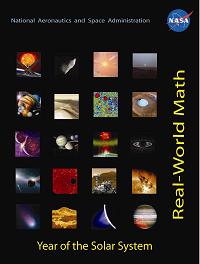 Year of the Solar System Math Guide (2013)
164 Problems
This collection of math problems covers the 20 science topic themes presented by the NASA/JPL Year of the Solar System website
(Click Here) covering the solar system, planets, the search for life, and robotics.
[PDF: 20.4 Mby ]
Year of the Solar System Math Guide (2013)
164 Problems
This collection of math problems covers the 20 science topic themes presented by the NASA/JPL Year of the Solar System website
(Click Here) covering the solar system, planets, the search for life, and robotics.
[PDF: 20.4 Mby ]
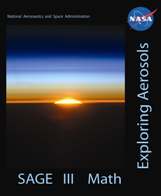 SAGE III Explores Aerosol Math (2014)
18 Problems; 2 Interactive Labs
This book explores the properties of atmospheric aerosols being studied by the NASAQ SAGE III instrument onboard the International Space Station. Also includes two interactive Excel Spreadsheets to study
opacity [Download file], light transmission and Earth limb sunset and sunrise observations of
the atmosphere [Download file]. Download Book:
[PDF: 20.4 Mby ]
SAGE III Explores Aerosol Math (2014)
18 Problems; 2 Interactive Labs
This book explores the properties of atmospheric aerosols being studied by the NASAQ SAGE III instrument onboard the International Space Station. Also includes two interactive Excel Spreadsheets to study
opacity [Download file], light transmission and Earth limb sunset and sunrise observations of
the atmosphere [Download file]. Download Book:
[PDF: 20.4 Mby ]
Additional Math Resources
- Northern Lights and Solar Sprites (Grades 1-5) Many different areas in solar and space science are covered in highly interactive exercises. These include studying convection on the Sun, solar flares, how to design a rocket payload, and the general subject of how the Sun affects the Earth. It was specifically designed to fill a well-known gap in NASA's offerings for the lower grades, and to do so in a way that is both fun, and well-integrated with national science benchmarks and standards.
- Solar Storms and You! (Grades 7-9) This series of six workbooks has been adopted in a number of school districts in Maryland, California and Illinois. POETRY has also participated in numerous conferences and workshops, presenting selected activities to teachers. The six chapters are: Solar Activity | The Solar Wind | Magnetic Storms | Aurora | Satellite Design | Human Impacts
- Blackout: The Video (Grades 7-9)A middle school-level science module in the Event-Based Science program supported by the National Science Foundation. The workbook I will be published by Addison-Wesley in early 2000. It is a role-based curriculum package that lets students operate as engineers, scientists and technicians to understand the cause of a simulated electrical power blackout patterned after the March 1989 Quebec blackout which affected 6 million people. Students read news stories about the impacts of blackouts, their scientific causes, and conduct hands-on experiments in electricity and magnetism.To order a copy, contact: Request Coordination Center , Code 633, Goddard Space Flight Center , 301) 286-6695 (Email) request@nssdc.gsfc.nasa.gov Cost = $10.00 Length: 20 minutes The Video may also be ordered through NASA/CORE by visiting their Web Page
- IMAGE Explores... (Grades 7-10) A series of 1-page NASA Education Briefs that contain information about a specific IMAGE instrument or technology issue on the front page. On the back of the page, there is a classroom activity that students can work on that picks up on some aspect of the main essay. Typical activities may exercise geometric skills, algebraic manipulation, or graphing. The Plasmasphere | The Aurora | The Magnetosphere | The Ring Current
- Exploring the Earth's Magnetic Field(Grades 9-11)This is a workbook of 23 activities spanning the needs of K-12 teachers who want to discuss Earth's magnetism in varying degrees of detail. In includes web-based activities, and a variety of hands-on experiments with magnets and electromagnetism.
- The Classroom Magnetometer (Grades 7-10)Students will build and operate a simple magnetometer using a soda bottle and a bar magnet. They will use it to monitor changes in Earth's magnetic field. They will study magnetic storms and investigate their properties in time and space. They will make measurements and perform simple statistical analysis.
- The Instruments of IMAGE(Grades 10-12)This is a pair of high school-level workbooks featuring advanced problems in mathematics and science that are based on experiments being performed with the IMAGE satellite. Introduction Guide | Spacecraft and Data
- Tracking a Solar Storm(Grades 10-12)This is a pair of high school-level workbooks featuring advanced problems in mathematics and science that are based on experiments being performed with the IMAGE satellite. Part 1 | Part 2
- The Northern Lights(Grades 7-8)This is a workbook of 10 activities targeted at Grade 7-8 that explores the Northern Lights. The activities include essays, triangulation, parallax, geometry, calculator mathematics, graph analysis, prediction and forecasting.
- Exploring Space Science Mathematics(Grades 7-9)This series of math activities will help students understand some of the real-life applications of mathematics in the study of the Sun and Earth as a system.
- Calculating the Distance to the Sun During a Transit of Mercury using Satellite Observations of Parallax (Grades 9-10)This is a geometry problem that teaches students about the parallax effect and how it is used to determine distances in space. In this example, we use images from the TRACE satellite taken during the Transit of Mercury to measure the parallax angle, and determine the distance from Earth to the Sun.
- Calculating the Distance to the Sun During a Transit of Venus using Satellite Observations of Parallax (Grades 9-10)This is a geometry problem that teaches students about the parallax effect and how it is used to determine distances in space. In this example, we use images from the TRACE satellite taken during the rare, 2004 Transit of Venus to measure the parallax angle, and determine the distance from Earth to the Sun.