
Books from SpaceMath
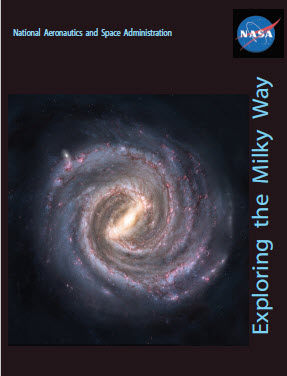
Exploring the Milky Way - This collection of activities is intended for students looking for additional challenges in the math and physical science curriculum in grades 6 through 8, but where the topics are drawn from astronomy and space science. As a science extension, ‘Exploring the Milky Way’ introduces students to mapping the shape of the Milky Way galaxy, and how to identify the various kinds of galaxies in our universe. Students also learn about the shapes and sizes of other galaxies in our universe as they learn how to classify them. The math problems cover basic scientific notation skills and how they apply to working with ‘astronomically large’ numbers. It also provides exercises in plotting points on a Cartesian plane to map the various features of our Milky Way. [Click here].
Math problems about our Universe and Deep Space
Problem 663: HST - The Hubble Search for the Farthest Galaxy in the Universe Students learn about the recent discovery of z8_GND_5296 what may be the farthest known galaxy in our visible universe whose light left the galaxy when the universe was only 700 million years old. They use a simple linear equation to estimate the galaxys look-back time, and learn about the cosmological redshift. [Grade: 6-8 | Topics: working with simple equations; solving for X] [Click here]
Problem 594: A Number Puzzle about the Origin of Our Universe Students learn about the Big Bang by solving a number puzzle for missing words using solutions to a variety of problems taken from Algebra 1 topics. [Grade: 6-8 | Topics: distance between two points; slopes; linear equations; dilations; scientific notation] [Click here]
Problem 553:Colliding Galaxies - The future of our Milky Way Students explore the collision of two galaxies and estimate from their present speed, separation and acceleration how long it will be before they have collided. [Grade: 9-12 | Topics: unit conversions; scientific notation; ballistic equation; solvimg quadratic equations] [Click here]
Problem 513: The Remarkable Gamma Ray Burst GRB 130427A Students work with the surface area of a sphere, metric conversions and scientific notation to calculate the total power of this distant supernova event. [Grade: 8-10 | Topics: surface area of sphere; scientific notation] [Click here]
Problem 511: Giant Gas Cloud in System NGC 6240 Students use scientific notation and volume of sphere to estimate the density of the gas cloud, and the number of hydrogen atoms per cubic meter. [Grade: 8-10 | Topics:Volume of a sphere; scientific notation; unit conversion ] [Click here]
Problem 510: Planck Mission Sees the Ancient Universe Clearly Students work with an image of the universe when it was 370,000 years old and determine from simple scaling and proportions the sizes of the features seen in the image compared to the Milky Way. [Grade: 6-8 | Topics: scale and proportion; angular measure] [Click here]
Problem 501: Exploring the Most Distant Galaxies with Hubble Students use recent Hubble Extreme Deep Field data and a polynomial to determine the light travel time between distant galaxies and Earth. [Grade: 11-12 | Topics: polynomials; linearization] [Click here]
Problem 487: The Hubble eXtreme Deep Field Students use the Hubble XDF to estimate the number of galaxies in the visible universe. [Grade: 6-8 | Topics: Counting, areas, proportions ] [Click here]
Problem 462: Using a Gravity Lens to Weigh a Cluster of Galaxies Students explore how the geometry of a gravity lens can be used to measure the mass of the object producing the gravity. [Grade: 9-12 | Topics: algebra; Scientific Notation] [Click here]
Problem 460: Fermi Explores the High-Energy Universe Students work with percentages to explore the identities of the 1873 gamma-ray sources detected by NASAs Fermi Observatory [Grade: 6-8 | Topics: percentages; pie graphs] [Click here]
Problem 418: Supercomputers: Modeling colliding neutron stars! Students use a series of time-lapse images calculated using a supercomputer to determine the speed of collision of two neutron stars, and whether they will form a black hole afterwards. [Grade: 8-10 | Topics: distance=speed x time; scale model; triangle and circle geometry; circumference] [Click here]
Problem 417: Estimating the Size and Mass of a Black Hole Students use a simple formula to estimate the size of a black hole located 3.8 billion light years from Earth, recently studied by NASA's Chandra and Swift satellites. [Grade: 8-10 | Topics: distance=speed x time] [Click here]
Problem 400: The Most Distant Objects in the Universe Students use a table of the most distant known events and objects in the universe to create a timeline of the universe soon after the Big Bang. [Grade: 6-8 | Topics: Working with millions and billions; elapsed time] [Click here]
Problem 399: A Galactic City in the Far Reaches of the Universe Students work with an image of a distant cluster of galaxies to determine its scale compared to nearby galaxies. [Grade: 6-8 | Topics: Scale; proportion; metric measurement; unit conversion] [Click here]
Problem 388: Hubble Detects More Dark Matter Students learn about how astronomers estimate the amount of invisible dark matter in a cluster of galaxies by comparing its visible mass against the speeds of the galaxies to 'weigh' the cluster' [Grade: 8-10 | Topics: evaluating functions; Scientific notation] [Click here]
Problem 330: Fermi Detects Gamma-rays from the Galaxy Messier-82 Based on a recent press release, students work with a log-log plot to show that straight lines on this plot represent power-law functions. They use this fact to determine, by interpolation, the strength of the gamma-rays from this galaxy. [Grade: 10-12 | Topics: power-laws; log-log graphing; linear regression] [Click here]
Problem 323: How Many Quasars are There? Students use a piecewise function that estimates how many quasars are found in a given area of the sky. The function is integrated to determine the estimated total number of quasars across the entire sky. [Grade: 11-12 | Topics: Piecewise functions; integral calculus] [Click here]
Problem 322: Rotation Velocity of a Galaxy Students examine a simple model of the rotation of a galaxy to investigate how fast stars orbit the centers of galaxies in systems such as the Milky Way and Messier-101. [Grade: 10-12 | Topics: Algebra, limiting form of functions; derivitives] [Click here]
Problem 313: Exploring the Big Bang with the LHC Two simple equations allow students to compute the temperature and energy of matter soon after the Big Bang, and compare these with energies available at the LHC. [Grade: 9-12| Topics: Algebra; Scientific Notation; Unit conversions] [Click here]
Problem 312: Exploring the Large Hadron Collider The Large Hadron Collider collides protons at very high energy to create new forms of matter. Students explore unit conversions related to energy and mass. [Grade: 9-12 | Topics: Scientific Notation] [Click here]
Problem 311: The Volume of a Hypersphere This problem extends student understanding of volume to include higher-dimensional spheres and their unusual properties. A simple recursion relation is used to calculate the volume formulas for spheres in dimensions 4 through 10. [Grade: 9-12 | Topics: Algebra II; Geometry; recursion relations] [Click here]
Problem 310: Energy and Mass - Same things but different! Students use unit conversions to explore the relationship between mass and energy. [Grade: 8-10 | Topics: Unit COnversions; Scientific Notation] [Click here]
Problem 309: The Energy of Empty Space Students explore the energy of 'empty space' and its relationship to the mass of the Higgs Boson using a simple quartic polynomial. [Grade: 10-12 | Topics: Properties of functions; polynomials; Critical points] [Click here]
Problem 308: The Higgs Boson and the Mystery of Mass The search for the Higgs Boson is underway at the Large Hadron Collider (LHC). In this problem, students explore how the mass of this particle is believed to depend on the energies used to form it by studying a simple quartic polynomial. [Grade: 10-12 | Topics: Properties of functions; polynomials; Critical points] [Click here]
Problem 307: The Elementary Particle Masses Students compare the masses and mass differences between elementary particles using units common to physics such as the electron Volt. [Grade: 9-12 | Topics: Scientific Notation; unit conversion] [Click here]
Problem 291: Calculating Black Hole Power Students use a simple formula to calculate how much power is produced by black holes of various sizes as they absorb matter from nearby stars and gas clouds. [Grade: 9-12 | Topics: Scientific Notation; evaluating simple formulas; unit conversion] [Click here]
Problem 289: Chandra Spies the Longest Sound Wave in the Universe Students use an image of sound waves produced by a massive black hole to determine wavelength, and comparisons with musical scale to find how many octaves this sound wave is below the wavelength of middle-C. [Grade: 6-8 | Topics: metric measurement; scaling; Scientific Notation; exponents] [Click here]
Problem 288: Fermi Observatory Measures the Lumps in Space Students use timing data obtained by the Fermi Observatory of a powerful gamma-ray burst 10 billion light years away, to determine how lumpy space is based on travel time delays between the lowest and highest-energy gamma-rays. [Grade: 9-12 | Topics: Scientific Notation; Evaluating an equation with multiple factors] [Click here]
Problem 285: Chandra Sees the Most Distant Cluster in the Universe Students work with kinetic energy and escape velocity to determine the mass of a distant cluster of galaxies by using information about its x-ray light emissions. [Grade: 9-12 | Topics: Algebra I; Solving for X; Scientific notation] [Click here]
Problem 239: Counting Galaxies with the Hubble Space Telescope Students use an image of a small area of the sky to estimate the total number of galaxies in the universe visible from Earth. [Grade: 8-10 | Topics: area, angular measure] [Click here]
Problem 233: The Milky Way: A mere cloud in the cosmos- Students compare the average density of the Milky Way with the density of the universe. [Grade: 8-10 | Topics: Volume of disk, density, scientific notation] [Click here]
Problem 230: Galaxy Distances and Mixed Fractions- Students use the relative distances to nearby galaxies expressed in mixed numbers to determine distances between selected galaxies. [Grade: 3-5 | Topics: Basic fraction math.] [Click here]
Problem 222: Kelvin Temperatures and Very Cold Things- Students convert from Celsius to Fahrenheit and to Kelvin using three linear equations. [Grade: 5-8 | Topics: Evaluating simple linear equations for given values.] [Click here]
Problem 219: Variables and Expressions from Around the Cosmos- Students evaluate linear equations describing a variety of astronomical situations. [Grade: 6-8 | Topics: Evaluating simple one-variable equations.] [Click here]
Problem 213: Kepler: The hunt for Earth-like planets- Students compare the area of a star with the area of a planet to determine how the star's light is dimmed when the planet passes across the star as viewed from Earth. This is the basis for the 'transit' method used by NASA's Kepler satellite to detect new planets. [Grade: 6-8 | Topics: Area of circle; ratios; percents.] [Click here]
Problem 212: Finding Mass in the Cosmos- Students derive a simple formula, then use it to determine the masses of objects in the universe from the orbit periods and distances of their satellites. [Grade: 9-12| Topics: Scientific Notation; Algebra II; parametric equations] [Click here]
Problem 192: The Big Bang - Cosmic Expansion - Students explore the expansion of the universe predicted by Big Bang cosmology [Grade: 10-12| Topics: Algebra, Integral Calculus] [Click here]
Problem 191: Why are hot things red? - Students explore the Planck Function using graphing skills, and calculus for experts, to determine the relationship between temperature and peak wavelength. [Grade: 10-12| Topics: Algebra, graphing, differential calculus] [Click here]
Problem 186: Collapsing Gas Clouds and Stability- Students use the derivative to find an extremum of an equation governing the pressure balance of an interstellar cloud. [Grade: 11-12| Topics: differentiation; finding extrema; partial derivitives] [Click here]
Problem 170: Measuring Star Temperatures- Students use a simple formula to determine the temperatures of stars, and to use a template curve to analyze data for a specific star to estimate its temperature. [Grade: 6-8 | Topics: algebra, graph analysis] [Click here]
Problem 160: The Relative Sizes of the Sun and Stars- Students work through a series of comparisons of the relative sizes of the sun compared to other stars, to create a scale model of stellar sizes using simple fractional relationships. ( e.g if Star A is 6 times larger than Star B, and Star C is 1/2 the size of Star B, how big is Star C in terms of Star A?) [Grade: 4-6 | Topics: working with fractions; scale models] [Click here]
Problem 159: Galaxies to Scale - Students explore the relative sizes of the Milky Way comparedto other galaxies to create a scale model of galaxies, similar to the methods in Problem 161. [Grade: 4-6 | Topics: working with fractions; scale models] [Click here]
Problem 152: The Hubble Law - Students plot the speed and distance to 7 galaxies and by deriving the slop of the linear model for the data points, obtain an estimate for the expansion rate of the universe known as Hubble's Constant. [Grade: 6-8 | Topics: Plotting data; determining the slope of the data;] [Click here]
Problem 150: Cosmic Bar Graphs - Students interpret simple bar graphs taken from astronomical data. [Grade: 3-5 | Topics: finding maxima and minima; fractions; extrapolating data] [Click here]
Problem 146 Black Hole Power Students calculate how much power is produced as matter falls into a rotating and a non-rotating black hole including solar and supermassive black holes. [Grade: 9 - 11 | Topics:Scientific Notation; Spherical shells; density; power] [Click here]
Problem 144 Exploring Angular Size Students examine the concept of angular size and how it relates to the physical size of an object and its distance. A Chandra Satellite x-ray image of the star cluster NGC-6266 is used, along with its distance, to determine how far apart the stars are based on their angular separations. [Grade: 7 - 10 | Topics:Scientific Notation; degree measurement; physical size=distance x angular size.] [Click here]
Problem 136 Black Holes---Part IV Students explore how much energy is generated by stars and gas falling into black holes. The event horizon radius is calculated from a simple equation, R = 2.95 M, and energy is estimated from E = mc^2. [Grade: 7 - 10 | Topics:Scientific Notation; Working with equations in one variable to first and second power.] [Click here]
Problem 128 Black Holes - I Students learn about the most basic component to a black hole - the event horizon. Using a simple formula, and scientific notation, they examine the sizes of various kinds of black holes. [Grade: 8 - 12 | Topics:Simple linear equations; scientific notation] [Click here]
Problem 123 A Trillion Here...A Trillion There Students learn to work with large numbers, which are the heart and soul of astronomical dimensions of size and scale. This activity explores the number 'one trillion' using examples drawn from the economics of the United States and the World. Surprisingly, there are not many astronomical numbers commonly in use that are as big as a trillion. [Grade: 5-9 | Topics:add, subtract, multiply, divide.] [Click here]
Problem 111 Scientific Notation III In this continuation of the review of Scientific Notation, students will perform simple multiplication and division problems with an astronomy and space science focus. [Grade: 5-9 | Topics:Scientific notation - multiplication and division] [Click here]
Problem 110 Scientific Notation II In this continuation of the review of Scientific Notation, students will perform simple addition and subtraction problems. [Grade: 5-9 | Topics:Scientific notation - addition and subtraction] [Click here]
Problem 109 Scientific Notation I Scientists use scientific notation to represent very big and very small numbers. In this exercise, students will convert some 'astronomical' numbers into scientific notation form. [Grade: 5-9 | Topics:Scientific notation - conversion from decimal to SN] [Click here]
Problem 58 How many stars are there? - For thousands of years, astronomers have counted the stars to determine just how vast the heavens are. Since the 19th century, 'star gauging' has been an important tool for astronomers to assess how the various populations of stars are distributed within the Milky Way. In this activity, students will get their first taste of star counting by using a star atlas reproduction and bar-graph the numbers of stars in each magnitude interval. They will then calculate the number of similar stars in the sky by scaling up their counts to the full sky area. [Grade level: 6-8 | Topics: Positive and negative numbers; histogramming; extrapolating data] [Click here]
Problem 56 The Sombrero Galaxy Close-up - The Sombrero Galaxy in Virgo is a dazzling galaxy through the telescope, and has been observed in detail by both the Hubble Space Telescope and the Spitzer Infrared Observatory. This exercise lets students explore the dimensions of this galaxy as well as its finest details, using simple image scaling calculations. [Grade level: 9-11 | Topics: Finding the scale of an image; measurement; decimal math] [Click here]
Problem 54 Exploring Distant Galaxies - Astronomers determine the redshifts of distant galaxies by using spectra and measuring the wavelength shifts for familiar atomic lines. The larger the redshift, denoted by the letter Z, the more distant the galaxy. In this activity, students will use an actual image of a distant corner of the universe, with the redshifts of galaxies identified. After histogramming the redshift distribution, they will use an on-line cosmology calculator to determine the 'look-back' times for the galaxies and find the one that is the most ancient galaxy in the field. Can students find a galaxy formed only 500 million years after the Big Bang? [Grade level: 6-8 | Topics: Decimal math; using an online calculator; Histogramming data] [Click here]
Problem 50 Measuring the Speed of a Galaxy. - Astronomers can measure the speed of a galaxy by using the Doppler Shift. By studying the spectrum of the light from a distant galaxy, the shift in the wavelength of certain spectral lines from elements such as hydrogen, can be decoded to give the speed of the galaxy either towards the Milky Way or away from it. In this activity, students will use the formula for the Doppler Shift to analyze the spectrum of the Seyfert galaxy Q2125-431 and determine its speed. [Grade level: 6-8 | Topics: Interpolating data in a graph; decimal math] [Click here]
Problem 49 A Spiral Galaxy Up Close. - Astronomers can learn a lot from studying photographs of galaxies. In this activity, students will compute the image scale (light years per millimeter) in a photograph of a nearby spiral galaxy, and explore the sizes of the features found in the image. They will also use the internet or other resources to fill-in the missing background information about this galaxy. [Grade level: 6-8 | Topics: Online research; Finding the scale of an image; metric measurement; decimal math] [Click here]